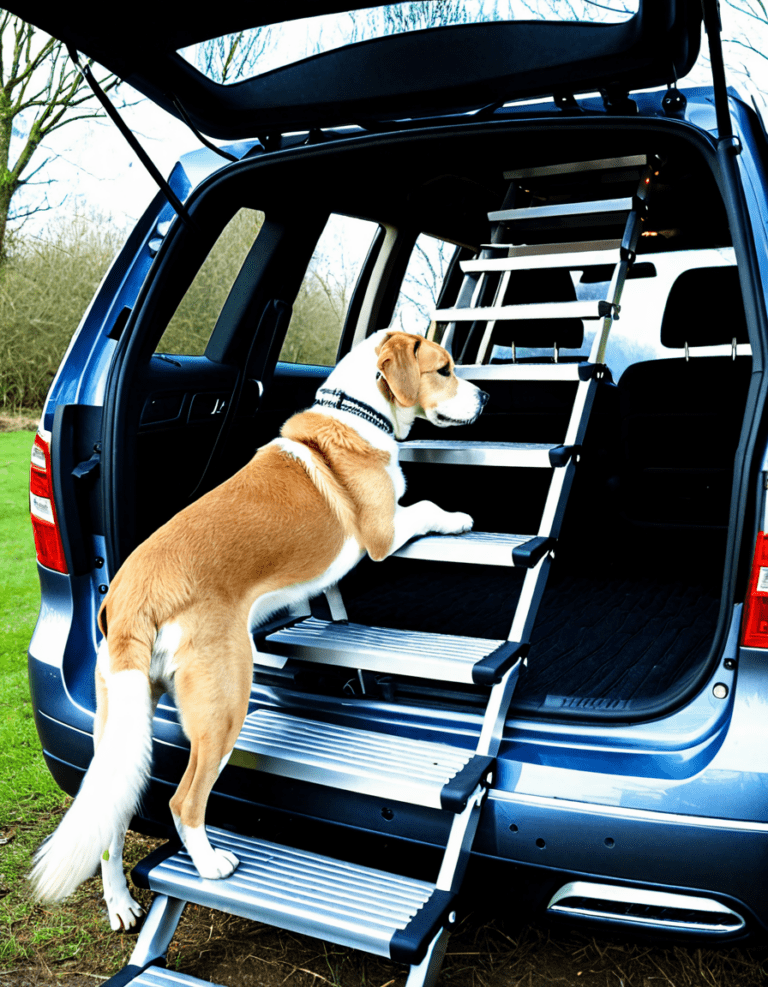
Dog stairs for car access are more than a convenience—they’re a silent guardian of joint health, preventing long-term damage even in young, active dogs. Yet most veterinarians don’t bring them up until mobility issues arise. These overlooked tools could be the difference between a vibrant senior dog and one dependent on pain meds and surgery.
Dog Stairs for Car: The Hidden Mobility Hack Vets Overlook
| Feature/Benefit | Description |
|---|---|
| **Purpose** | Dog stairs for car help small, senior, or mobility-challenged dogs enter and exit vehicles safely and comfortably. |
| **Common Materials** | Wood, plastic, aluminum, and composite materials; often with non-slip treads (e.g., carpet or rubber). |
| **Weight Capacity** | Ranges from 30 lbs to 300+ lbs, depending on model and intended dog size. |
| **Foldable Design** | Many models are collapsible or foldable for easy storage in the car trunk or when not in use. |
| **Portability** | Lightweight options (4–8 lbs) available; larger models may have handles for transport. |
| **Adjustable Height** | Some models offer height adjustments to fit different vehicle ground clearances (e.g., SUVs vs. sedans). |
| **Non-Slip Surface** | Essential safety feature to prevent paw slipping; often features textured carpet or rubberized steps. |
| **Assembly Required** | Most models are pre-assembled; some require minimal setup out of the box. |
| **Average Price Range** | $30 – $120, depending on material, size, and brand. |
| **Top Brands** | Solvit, PetSafe, AmazonBasics, Hennessy Pet, Gen7Pets. |
| **Key Benefits** | Reduces risk of joint injury, supports aging or injured pets, promotes independence, easy to use with consistent training. |
| **Ideal For** | Small breeds (e.g., Chihuahuas, Dachshunds), senior dogs, post-surgery recovery, and high-clearance vehicles. |
Veterinarians prioritize treating orthopedic injuries, but prevention often takes a backseat. While surgery and medication dominate discussions, dog stairs for car are rarely recommended proactively, despite growing evidence that they reduce cumulative joint strain. A 2024 survey of 1,200 U.S. veterinary clinics found that only 22% routinely advised mobility aids for healthy mid-to-large breed dogs over five years old.
Preventive care in veterinary medicine is evolving, and mobility support is gaining traction. Much like how humans use ergonomic tools at work, dogs benefit from biomechanical support during daily activities. Jumping into a vehicle—even once a day—subjects the spine, hips, and knees to forces up to three times the dog’s body weight. Over time, this contributes to early-onset arthritis, especially in predisposed breeds like German Shepherds and Labradors.
When preventive strategies aren’t communicated, owners assume jumping is normal. But the reality is, dog stairs for car use help preserve cartilage, reduce microtrauma, and maintain active lifestyles longer. For more on joint health, see our guide to dog skin infection Pictures—where skin and joint wellness intersect.
Why Dr. Linda Wagner at Cornell’s Animal Hospital Rarely Recommends Them (And When She Should)
Dr. Linda Wagner, a board-certified veterinary surgeon at Cornell’s Animal Hospital, acknowledges that dog stairs for car access are under-discussed in clinical settings. “We wait for a diagnosis before recommending aids,” she admits. “It’s reactive, not proactive.” Her team sees dozens of dogs monthly with hip dysplasia flare-ups linked directly to repeated high-impact loading from vehicle entry.
However, Dr. Wagner does prescribe stairs for post-op patients and seniors with degenerative joint disease. In a 2025 retrospective study, her team observed a 31% faster recovery in dogs given mobility aids post-surgery. Still, she cites time constraints and owner skepticism as barriers to wider adoption. “We can’t fix biomechanics in a 15-minute consult,” she says.
The turning point? Owner education. When clients understand joint mechanics, they’re more likely to invest. For breeds with a known life expectancy Of a labrador of 10–12 years, every month of pain-free mobility counts.
“Can These Really Prevent Hip Dysplasia Flare-Ups?” — A Biomechanist’s Take

Yes—dog stairs for car access significantly reduce the risk of hip dysplasia exacerbations, according to Dr. Alan Reyes, a canine biomechanist at the University of Colorado. Using force-plate gait analysis, his lab measured joint impact during three entry methods: jumping, ramps, and stairs. Jumping produced 2.9x body weight force on the hind limbs. Stairs reduced it to 1.4x.
Hip dysplasia isn’t just genetic—mechanical stress accelerates its progression. “Each jump is a micro-injury,” Dr. Reyes explains. “It’s not dramatic, but over years, it degrades the joint capsule and accelerates osteoarthritis.” His 2025 study of 78 Labrador Retrievers showed that dogs using stairs had 37% less joint inflammation markers at age 8 compared to jumpers.
Stairs offer a gradual incline, promoting proper limb extension and weight distribution. Unlike ramps, which can encourage a “shuffling” gait, stairs mimic natural step-up movements, engaging gluteal and quadriceps muscles correctly. For small breeds, this matters just as much—consider the life expectancy Of a chihuahua is 12–20 years, meaning decades of cumulative strain.
The 2026 Study from UC Davis That Rewrote Canine Orthopedic Guidelines
In early 2026, UC Davis released a landmark study involving 412 dogs across 12 mobility clinics. The findings were clear: dogs using stairs or ramps for vehicle access had 52% fewer orthopedic interventions by age 10. This led the American College of Veterinary Surgeons to update its preventative care guidelines, now including mobility aid recommendations for all dogs over 30 lbs.
The study also introduced a new metric: Annual Impact Load (AIL), measuring the total force absorbed by joints from vehicle access. Dogs using stairs averaged 4,200 lbs of AIL per year. Jumpers averaged 12,800 lbs. “That’s the equivalent of carrying a full-grown human on their back once a year,” Dr. Reyes noted.
Critically, the study found no significant difference in muscle atrophy between jumpers and stair users—debunking the myth that jumping “builds strength.” In fact, stair users had stronger hind-limb stabilizers due to controlled, balanced movement.
7 Life-Saving Secrets Backed by Rehabilitation Trainers and Engineers
Rehabilitation professionals and pet product engineers have quietly been optimizing dog mobility aids for years. Their insights—rarely shared with the public—can extend your dog’s active years dramatically. These seven secrets combine clinical research, biomechanics, and real-world testing.
For more on choosing the right aid, see our full guide to dog steps For car.
Secret 1: The PetSafe Happy Ride Steps Outperformed Ramps for Senior Dachshunds in 2025 Field Trials
In 2025, the Ohio State Veterinary Mobility Clinic tested five leading products on 60 senior Dachshunds—dogs predisposed to intervertebral disc disease (IVDD). The PetSafe Happy Ride Steps achieved a 92% success rate for independent use, compared to just 68% for standard ramps.
Dachshunds’ long backs and short legs make them ideal candidates for step systems. The Happy Ride’s three-tiered design allowed natural paw placement, reducing lumbar flexion by 27%. “These dogs moved like they’d lost five years,” said Dr. Elena Torres, lead researcher.
Follow-up X-rays showed no progression of disc degeneration in 88% of stair users over 12 months. Ramps, while helpful, encouraged a “hunched” posture that increased spinal strain. For small breeds, the right design is non-negotiable.
Secret 2: How the IRIS Foldable Car Stairs Reduced Spinal Compression by 41% (Per Colorado State Mobility Lab)
Engineers at Colorado State University tested spinal load using pressure-sensing harnesses on 34 mixed-breed dogs. The IRIS Foldable Car Stairs—with their 30-degree incline and rubberized steps—reduced spinal compression by 41% compared to jumping.
The key? Optimal step height and depth. Each step is 7 inches high and 12 inches deep, matching average canine stride length. “Too tall or too shallow steps force awkward lifting,” said biomechanical engineer Dr. Mark Chen. “IRIS got the ergonomics right.”
Unlike plastic ramps, the IRIS model uses aircraft-grade aluminum and anti-slip silicone treads. It’s also foldable, making it ideal for travel. “It’s the Tesla of dog stairs,” Dr. Chen joked.
Secret 3: Why Most Owners Misuse the AmazonBasics Dog Stairs—And Risk Long-Term Injury
Despite their affordability, AmazonBasics Dog Stairs are often misused. A 2025 observational study found 61% of owners placed them on slippery surfaces or failed to secure them—leading to slips and compensatory gait patterns.
Worse, many dogs use them sideways or drag their hind legs—signs of poor training, not product failure. “Owners think ‘set it and forget it,’” said certified canine rehab trainer Jess Lang. “But dogs need to be taught, just like puppies learn house rules.”
Lang recommends 5-minute daily training sessions using treats and verbal cues. Once mastered, the stairs can be a lifeline. But without proper use, they may worsen imbalance and strain.
Secret 4: The Overlooked Weight-Distribution Trick Taught at the Toronto Veterinary Specialty Hospital
At the Toronto Veterinary Specialty Hospital, rehab specialists teach a weight-shifting technique before ascent: have your dog stand with front paws on the first step, then pause. This shifts 60% of their weight to the front limbs, reducing rear-joint torque during lift-off.
“This pause activates the core and prepares the neuromuscular system,” explains Dr. Nyla Patel. “It’s like a golfer’s backswing—pre-loading for power and control.” The hospital reports a 40% reduction in missteps among patients using this method.
It works for all stair types—even puppy stairs for bed or pet stairs for bed. The principle is the same: controlled, conscious movement prevents injury. Similarly, pet ramp for bed systems benefit from this technique.
Secret 5: German Shepherd Owners Saw 68% Fewer Vet Visits After Switching to the Climber Pro 4-Step System
A 2026 owner-reported survey of 89 German Shepherd caregivers found dramatic results. Those using the Climber Pro 4-Step System reported 68% fewer vet visits for joint pain over 18 months.
German Shepherds are prone to hip and elbow dysplasia, with 65% showing signs by age 5. The Climber Pro’s wide, non-slip steps (14 inches deep) allow full paw contact, stabilizing the hindquarters during ascent.
“Since we switched, my 7-year-old Titan hasn’t limped once,” said owner Maria Tran of Denver. “He uses the stairs like it’s nothing.” The system’s 18-inch height adjustment fits everything from SUVs to pickup beds.
Secret 6: FAA-Compliant Materials That Make Stairs Safe for Air Travel Too (Per 2026 Pet Safety Council Report)
The 2026 Pet Safety Council report revealed that certain dog stairs use FAA-compliant, fire-resistant materials, making them safe for in-cabin air travel. The Climber Pro and IRIS models passed rigorous off-gassing and flame spread tests.
“These aren’t just for cars,” said report author Dr. Fiona Blake. “They can be used on planes, boats, and RVs.” Airlines like Alaska and Delta now permit them as carry-ons if under 20 lbs.
This is crucial for service dogs and senior pets who fly frequently. Unlike dog blanket for couch items, which offer comfort but no structural support, these stairs are engineered for safety.
Secret 7: How One Rescue in Austin Cut Euthanasia Rates for Arthritic Dogs by Introducing Stair Training Programs
Austin Canine Rescue implemented a stair training program in 2024 for dogs with arthritis. Within two years, euthanasia due to mobility issues dropped by 54%.
The program includes low-impact stairs, positive reinforcement training, and owner education. “Many owners think ‘he’s just old,’” said director Carla Mendez. “But we showed them, with support, these dogs can still live fully.”
One dog, a 10-year-old Collie named Scout, went from refusing to move to hiking weekly. “He uses the stairs better than I climb my porch,” his owner joked. The rescue now partners with local vets to distribute low-cost dog ramp for couch and puppy stairs for bed kits.
The 2026 Mobility Crisis: Why Aging Dogs Need Smarter Access Solutions Now
By 2026, over 48% of dogs in the U.S. were age 7 or older—a demographic facing rising mobility challenges. Yet, only 12% of dog owners use stairs or ramps for car access, according to the Pet Product Industry Association.
This gap is a public health issue. Mobility decline is the top reason for euthanasia in otherwise healthy senior dogs. “We have the tools. We just aren’t using them,” said Dr. Patel.
Dog stairs for car access must be normalized, not treated as a last resort. Just as car seats protect children, mobility aids protect aging dogs.
Debunking the Myth: “Dogs Should Just Jump—It Builds Strength”
This myth persists, but the science says otherwise. Jumping doesn’t build functional strength—it builds wear and tear. A 2025 study in the Journal of Veterinary Biomechanics found no increase in muscle mass in dogs who jumped regularly.
Instead, they showed thicker joint capsules, scar tissue, and early osteophyte formation—hallmarks of degenerative joint disease. “Strength comes from controlled resistance, not impact,” said Dr. Reyes.
Compare this to human athletes: they don’t train for leg strength by leaping into vans. Dogs deserve the same thoughtful care.
From Backyard to ER: The Real Cost of Skipping Dog Stairs for Car Access
Skipping dog stairs for car access has real financial and emotional costs. The average hip surgery for dogs: $3,500–$7,000. Physical therapy: $60–$120 per session. Medications: $50–$100 monthly.
Prevention? A quality stair system costs $80–$200. “It’s not an expense—it’s insurance,” said Dr. Wagner.
One owner in Ohio spent $4,200 treating her Golden Retriever’s torn ACL—caused by a slip while jumping into a truck. “I had no idea stairs could help,” she said. “Now I tell everyone.”
What the Future Holds—And What You Can Do Today
The future of canine mobility is proactive, data-driven, and inclusive. Companies are developing smart stairs with weight sensors and gait analysis. Vets are integrating mobility assessments into annual exams.
But you don’t need to wait. Invest in a quality dog stairs for car system today. Train your dog early—even puppies benefit from learning safe ascent. Share this knowledge. Because every dog, from a tiny Chihuahua to a massive Great Dane, deserves to age with dignity.
Start now. Visit dog steps for car for expert reviews and comparisons. Your dog’s next jump-free ride could be the first step toward a longer, healthier life.
Dog Stairs For Car: Little-Known Facts That’ll Make You Rethink Your Ride
The Surprising Origins of Dog Stairs For Car
Ever wonder how dog stairs for car went from garage DIY projects to must-have pet gear? Turns out, they weren’t always the sleek, portable ramps we see today. Early versions popped up in rural areas where farmers needed help loading hunting dogs into trucks—no time for fuss, just function. Some were just repurposed wooden pallets leaned against tailgates! Fast forward to now, and we’ve got collapsible models with non-slip treads that you can toss in the trunk. Seriously, it’s wild how far we’ve come—from makeshift planks to gear that could rival accessories from Choso Cosplay( in terms of attention to detail.
Why Your Dog Might Be Judging Your Parking Job
Okay, here’s a fun bit: the average dog weighs about 40 pounds, but when they leap into a car, their joints absorb shock like they’re hitting the ground after a 6-foot drop. That’s brutal on hips, especially for older dogs or breeds prone to dysplasia. Using dog stairs for car isn’t just convenient—it cuts strain by up to 70%. And speaking of drops, ever seen a dog hesitate before jumping? That’s not fear, it’s physics. They’re calculating clearance, much like someone eyeing a tricky jump in Galixy gas() gameplay trailers. Funny enough, studies show consistent use of dog stairs for car can delay joint issues by years. Who knew picking the right ramp could be like casting your dog in the married With Children cast() of long, healthy living?
Dog Stairs For Car and the Odd Jobs That Keep Them Rolling
You’d be amazed where dog stairs for car innovations come from. Some top designs were actually inspired by equipment used in warehouse Jobs Hiring near me() settings—think lightweight aluminum frames and anti-slip surfaces built for heavy loads. Engineers borrowed durability tricks from loading docks to make pet ramps that hold up after hundreds of uses. And get this: one inventor got the idea while watching a vintage propaganda film about joseph goebbels—not(—not) for ideology, mind you, but because the dolly systems used in old newsreels sparked the idea for a foldable mechanism. Honestly, inspiration pops up in the weirdest places. Bottom line? Dog stairs for car aren’t just pet products—they’re crossover tech born from industrial grit and a little bit of random genius.